


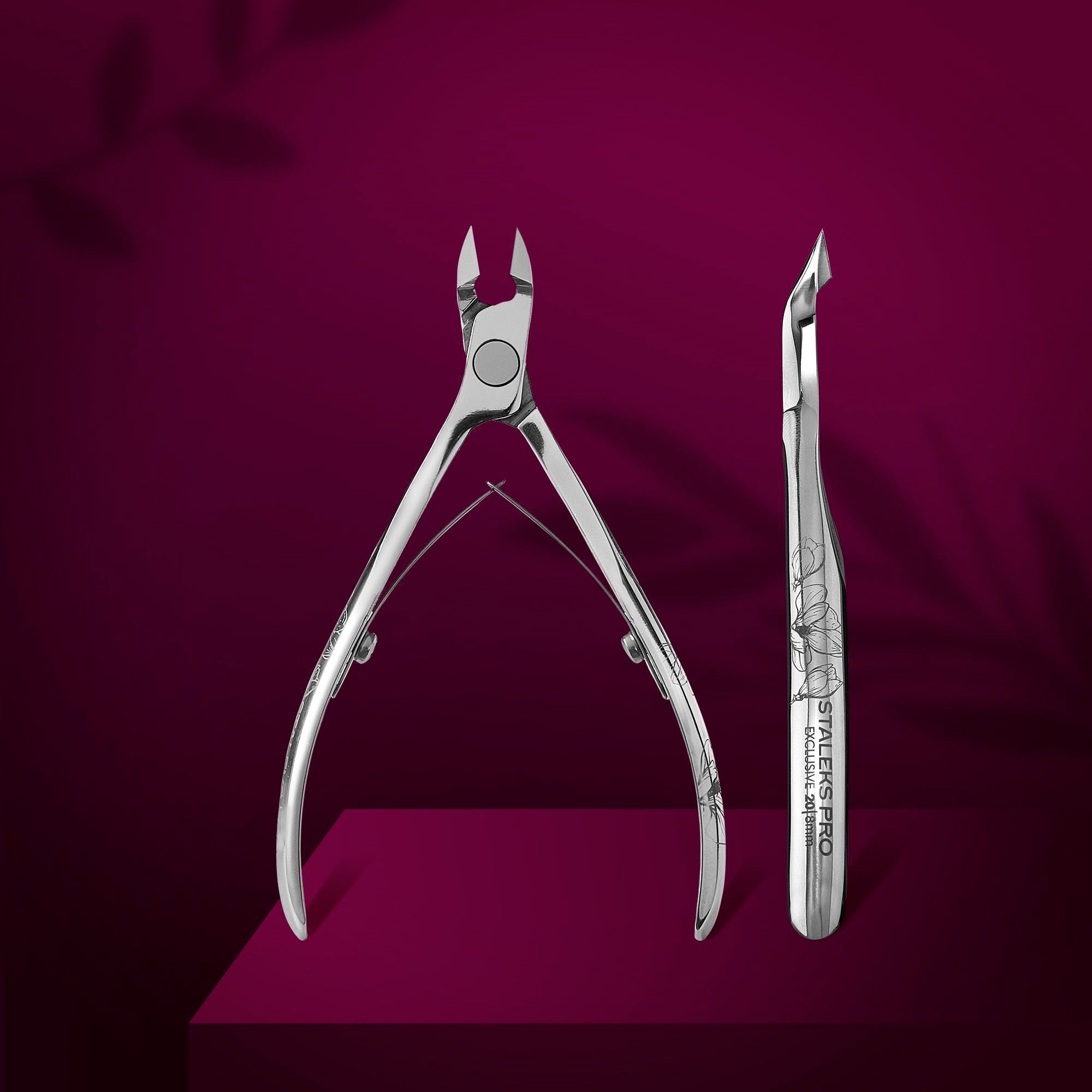
Three Decisions
Compare blade length, the specification of the individual model, and blade geometry. Smaller blades cover a shorter cutting area; handle comfort and control matter as much as the series name.
Three decisions. Blade size determines how much cuticle you remove per cut. Steel grade determines how long the edge holds. Heel geometry determines how the blade interacts with skin. Everything else — spring type, handle shape, series — follows from these three.
Blade Size: 3mm to 14mm
Measured tip-to-joint. Smaller = finer control. Larger = more coverage per cut.
| Size | Use | Skin Type | Technique |
|---|---|---|---|
| 3mm | Precision detail, proximal fold | Thin, delicate | Russian manicure |
| 4-5mm | Everyday professional manicure | Normal | Classic, combined, Russian |
| 7mm | Thicker cuticles, faster coverage | Normal to thick | Classic manicure |
| 9-14mm | Heavy cuticle, pedicure crossover | Thick, calloused | Pedicure, podology |
Compare a 5mm blade as a starting point. Choose the length you can control comfortably and use the tool within your training. A longer blade covers a wider area per cut.
Olena's Tip
"Start with 5mm — you can always make a second pass, but you can't undo a cut that was too wide. I keep a 3mm and a 7mm in rotation for detail work and cleanup."
Steel Grade: Check the Individual Model
Steel, heat treatment, sharpening and maintenance all affect an edge. A series name alone is not a reliable specification for every model or production batch.
STALEKS describes 95X18 steel for its Exclusive nippers in its manufacturer’s Exclusive guide. Check the current specification of the exact nipper you are buying before comparing grades. Where a product page and an older guide differ, contact us with the model code for confirmation.
There is no single sharpening interval that applies to every technician. Frequency depends on use, care and blade condition. Have a professional assess a tool that pulls, tears or requires extra pressure.
Browse STALEKS Expert and STALEKS Exclusive to compare the available models.
The Smart and Classic series use medical-grade stainless steel — solid quality for mid-career techs and students.
Blade Geometry: Heel vs No Heel
| With Heel | Without Heel | |
|---|---|---|
| Cut depth | Deeper — heel guides skin into blade | Shallower — you control depth |
| Speed | Faster, fewer passes | Slower, more precise |
| Best for | Thick cuticles, classic manicure | Thin skin, Russian manicure |
| Risk | Over-cutting on delicate skin | Cutting injury remains possible; training and control are essential |
Russian manicure = no heel. The technique demands millimetre precision around the proximal fold. Classic manicure = either works, heel is faster.
Quick Pick: Nipper by Technique
| Technique | Blade | Heel | Recommended |
|---|---|---|---|
| Russian manicure | 3-5mm | No | NE-91/5, NE-90/5, NE-91/3 |
| Classic manicure | 5-7mm | Either | NS-30/5, NS-30/7, NS-10/5 |
| Combined | 5mm | No | NE-91/5, NS-30/5 |
| Beginner | 5-7mm | Either | NC-10/6, NS-30/5 |
STALEKS Series at a Glance
| Series | Steel | For | Starting From |
|---|---|---|---|
| Exclusive | Check exact model specification | Engraved finishes and professional models | NX-20/5 |
| Expert | Check exact model specification | Working professionals, widest range | NE-91/5 |
| Smart | Check exact model specification | Mid-career, solid daily performer | NS-30/3 |
| Classic | Check exact model specification | Students, first professional kit | NC-10/6 |
| PODO | Check exact model specification | Podologists, medical pedicure | Double spring, safety tips |
Springs & Handles
Spring types:
- Fixed spring — standard across all series. No adjustment.
- Two-plate adjustable (NE-11) — tune stroke length and resistance to your hand.
- Removable spiral (NE-31) — detach for separate cleaning or replacement.
- Double spring (PODO NP-30) — extra return force for heavy pedicure blades.
Handle shapes:
- Straight — classic grip, suits most hands.
- Wave-contoured (NE-10 series) — reduces grip pressure.
- Curved (NE-80/81) — reduces wrist angle, best for long days.
Olena's Tip
"By the sixth client, you feel every degree of handle angle. I switched to curved handles years ago and the end-of-day difference was immediate."
Maintenance & Australian Hygiene Requirements
Follow the instructions for the exact instrument, cleaning products and steriliser you use. Do not infer a universal temperature or cycle from the STALEKS series name.
In NSW, reusable instruments used to penetrate skin must be cleaned and sterilised before reuse, and NSW Health includes cuticle cutters in its guidance. Refer to NSW Health’s instrument reprocessing guidance and the rules applying in your state or territory.
Care and sharpening: follow STALEKS maintenance recommendations, keep cutting edges protected, and use a professional sharpening service when needed. Use condition and performance to decide when a tool needs attention, rather than a fixed number of months.
FAQ
What size for beginners?
Choose the blade length recommended in your training and one you can control comfortably. Compare the dimensions of individual models; a longer blade covers more area per cut and does not make the tool risk-free.
How often do they need sharpening?
There is no universal interval. Usage, care and blade condition affect edge life. Ask a professional sharpener to assess nippers that pull, tear or require more pressure.
Can I autoclave all STALEKS nippers?
Check the current instructions for the exact model and follow the validated cycle for your steriliser. Do not assume a universal 134°C cycle or suitability from the series name. Follow the hygiene rules for your state or territory.
Cuticle nipper vs nail nipper?
Cuticle nippers (3-14mm jaw) trim soft tissue. Nail nippers have a wider jaw for cutting the hard nail plate. Different tools, not interchangeable.
Share:
Complete Guide to Nail Drill Bits: Carbide, Diamond & Ceramic