


Key Takeaway
Diamond bits are your detail tools — cuticle work, sidewalls, under the proximal fold. Carbide bits are your removal tools — stripping gel, cutting through acrylic, reducing callus. The colour band on the shank tells you grit: blue is medium (start here), red is fine, green is coarse.
In This Guide
You're looking at 230+ drill bits in our catalogue. Different materials, shapes, grits, head diameters. If you've ever stared at an e-file bit display and wondered which ones you actually need for a full day of clients, this guide cuts through it.
Three materials cover everything: diamond for precision, carbide for removal, ceramic for sensitive work. Within each material, the shape determines what the bit does and the colour band determines how aggressively it cuts. Once you understand those two axes, the catalogue stops being overwhelming.
What the Colour Bands Mean
The coloured ring on the shank indicates grit — how coarse the cutting surface is. This system is universal across diamond, carbide and ceramic bits from any professional manufacturer.
| Colour | Grit | When to Use |
|---|---|---|
| Yellow | Super fine | Final finishing, nail plate smoothing |
| Red | Fine | Cuticle detail, finishing passes, sensitive skin |
| Blue | Medium | General daily use — most techs start here |
| Green | Coarse | Heavy removal, thick gel, pedicure callus |
| Black | Super coarse | Acrylic removal, very thick build-up only |
If you're building your first set, blue (medium) handles 70% of daily work. Add red for finishing and green for removal days.
Diamond Bits — Precision & Detail
Diamond-coated bits have industrial diamond particles bonded to a metal head. They cut by abrasion rather than slicing, which gives you fine control at lower RPMs. They're the default choice for cuticle preparation, sidewall work, and anything near the proximal fold.
Shape matters more than grit for diamond bits. Here's what each shape is built for:
| Shape | Best For | Head Size |
|---|---|---|
| Flame | Cuticle area, lifting and cleaning the proximal fold | 1.8–2.3 mm |
| Rounded cylinder | Sidewalls, lateral folds, cleaning the nail perimeter | 2.3–2.5 mm |
| Ball | Cuticle pocket cleanup, pterygium removal | 2.1–2.5 mm |
| Pear / drop | Under-nail cleaning, wider cuticle areas | 4–5 mm |
| Needle | Tight lateral grooves, ingrown nail edges | 1–1.6 mm |
The flame shape outsells everything else in our store by a wide margin. It's the workhorse for Russian and combined manicure — you use the tip for lifting, the belly for cleaning, and the shoulder for smoothing. A 2.1mm flame in red (fine) is the single most popular drill bit we sell.
Pair the flame with a rounded cylinder for sidewall work. The cylinder's flat profile runs parallel to the lateral fold without digging in — something a flame tip can't do safely at speed.
For pterygium and cuticle pocket cleanup, the ball shape reaches where flames and cylinders can't. A 2.5mm ball in red finishes the job without over-cutting.
Olena's Tip
"I keep two flames in rotation — a red for cuticle prep and a blue for clients with thicker skin. Switching grit mid-service is faster than adjusting RPM and pressure constantly." — Olena Iablonska, Founder of Beauty Tools Australia
Browse all 88 diamond drill bits →
Carbide Bits — Gel & Acrylic Removal
Carbide (tungsten carbide) bits have machined flutes that slice material away in chips rather than grinding it to dust. They remove product fast — gel extensions, acrylic overlays, thick pedicure callus. Where diamond abrades, carbide cuts.
The flute count matters. Fewer flutes = more aggressive cut, more vibration. More flutes = smoother finish, less material removed per revolution. Most professional bits use a medium cross-cut pattern that balances speed with control.
| Shape | Best For | Head Size |
|---|---|---|
| Frustum (tapered cylinder) | Gel removal from the nail surface, even thinning | 4–6 mm |
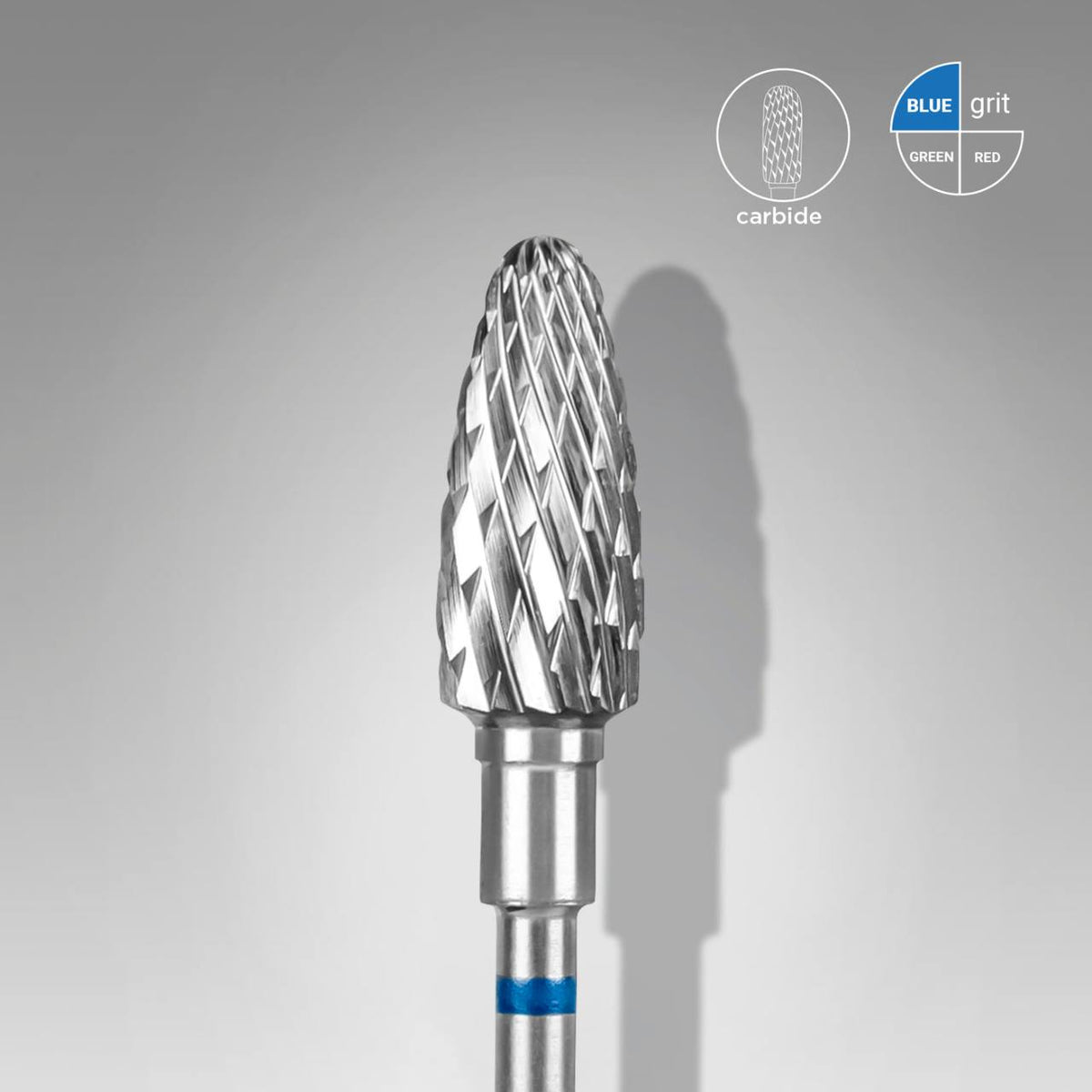
| Corn (barrel) | Acrylic removal, thick gel, pedicure callus | 5–6 mm |
| Cone | Under-nail cleaning, cuticle area with gel coating | 6 mm |
| Nail cleaner (mini) | Cleaning under the free edge, debris removal | 1.2 mm |
The frustum is the go-to for gel removal. Its tapered profile lets you work the nail surface at a shallow angle, thinning the product evenly without catching an edge. Blue (medium) for standard gel, green for thick builder gel or hard gel.
For acrylic and heavy pedicure work, the corn shape's wider barrel covers more surface area per pass. The purple band (extra coarse) exists specifically for thick acrylic removal.
Left-handed techs: STALEKS makes dedicated left-hand-cut versions of the cone and corn shapes. The flute direction is reversed so the bit pulls material away from the nail bed rather than pushing into it. Regular right-hand bits work against you — the cut direction matters more than most techs realise.
One specialist bit worth knowing about: the carbide nail cleaner. At just 1.2mm diameter, it's purpose-built for cleaning under the free edge — a task that's awkward with any standard-size bit.
Browse all 115 carbide drill bits →
Ceramic Bits — Low Heat, Smooth Finish
Ceramic bits generate less heat and vibration than carbide at the same RPM. They're a good choice for clients who report discomfort during removal, or for techs who work at higher speeds and want to reduce heat build-up. The trade-off: they wear faster than carbide and are more brittle — drop one on a hard floor and it shatters.
Ceramic works best for gel removal and surface prep where you'd otherwise use a medium carbide. The cone and corn shapes are most common. If your primary concern is client comfort during long removal sessions, ceramic is worth trying.
Olena's Tip
"Ceramic is fantastic for sensitive clients who flinch during gel removal. I keep one ceramic corn on hand specifically for those appointments — it's not my daily driver, but it solves a real problem." — Olena Iablonska, Founder of Beauty Tools Australia
Browse all 12 ceramic drill bits →
Quick Pick by Task
| Task | Material | Shape | Colour Band |
|---|---|---|---|
| Cuticle prep (Russian/combined) | Diamond | Flame | Red or blue |
| Sidewall cleaning | Diamond | Rounded cylinder | Blue |
| Pterygium removal | Diamond | Ball | Red |
| Gel removal | Carbide | Frustum | Blue or green |
| Acrylic removal | Carbide | Corn | Green or black |
| Pedicure callus | Carbide | Corn | Green |
| Heat-sensitive client removal | Ceramic | Corn or cone | Blue |
| Under-nail cleaning | Carbide | Nail cleaner mini | — |
| Final smoothing | Diamond | Any | Yellow or red |
A working starter kit: one diamond flame (red), one diamond cylinder (blue), one carbide frustum (blue), and one polishing bit. Four bits cover a full manicure service including gel removal.
Frequently Asked Questions
Diamond vs carbide — which should I buy first?
Both. They do different jobs. Diamond handles cuticle prep and detail work; carbide handles product removal. See the quick pick table for a four-bit starter set.
What RPM should I use for drill bits?
Diamond bits for cuticle work: 10,000–15,000 RPM. Carbide bits for gel removal: 15,000–25,000 RPM. Ceramic bits: same range as carbide but with less heat build-up. Always match RPM to your pressure — light pressure, higher RPM.
How long do drill bits last?
Diamond bits last 3–6 months with daily professional use before the coating wears smooth. Carbide bits last 6–12 months — the flutes dull gradually. Ceramic bits wear fastest, typically 2–4 months. Replace when you notice you're pressing harder to get the same result.
Can I autoclave drill bits?
Diamond and carbide bits are autoclave-safe. Ceramic bits can handle autoclaving but are more prone to micro-cracking over repeated cycles. All three types can be chemically disinfected.
Do I need left-handed drill bits?
If you're left-handed and using carbide bits, yes. The flute direction on standard bits pulls material the wrong way for left-hand use, increasing heat and reducing control. STALEKS EXPERT carbide range includes dedicated left-hand models.
What's the difference between a cone and a corn bit?
A cone tapers to a point — good for reaching tight areas like the cuticle zone on gel nails. A corn (barrel) has a consistent diameter along its working length — better for flat surface removal on the nail plate. See carbide shapes for details.
Share:
How to Choose Cuticle Nippers: Size, Steel Grade & Blade Type
Professional Nail Files: Metal Bases, Disposable Refills & the PapmAm System